

Around the World Show Notes 30 July 2026
This week's featured album is Ranjha by Shye Ben Tzur, Jonny Greenwood, and The Rajasthan Express.
This week on Around the World
You can listen to Around the World on Mixcloud
The first hour —— The second hour
Music by:
Airto Moreira & Ricardo Bacelar, Bojana Nikolic, Charles Maimarosia, Daft Punk, El Jarocho, Ichiko Aoba, Jordan Rakei & Femi Koleoso, Le Diable à Cinq, Lila Downs, Loimolan Voima, Luana Flores, Marcello De Carolis & Hiram Salsano, MESTIZA, Nana Osei Twum Barima, Orchestra Baobab, Orquesta Akokán, Os Pecados Tropicais, Slavyk, Tamikrest, Torridon, Trèvol, Veera Kuisma, and Willos’ & Massimo Giuntini

This week’s Featured Album:
Ranjha by Shye Ben Tzur, Jonny Greenwood, and The Rajasthan Express
It has been more than a decade since Shye Ben Tzur, Jonny Greenwood, and The Rajasthan Express released Junun. This week’s featured album, Ranjha follow-up to Janun, deepens the trio’s shared fascination with devotional poetry, Rajasthani folk traditions, and exploratory orchestration first forged in that landmark collaboration.
Shye Ben Tzur, Jonny Greenwood & The Rajasthan Express - Ranjha (Official Music Video)
Greenwood’s interest in Ben Tzur’s music was sparked by his wife, who introduced him to Ben Tzur’s work and encouraged the collaboration.
Greenwood first performed with Israeli composer Ben Tzur and his ensemble in 2014. For Junun, they built a temporary studio inside Mehrangarh Fort in Rajasthan and worked exclusively with local musicians. The Rajasthan Express brought together Qawwali singers, Muslim Roma performers, and a brass section seasoned in wedding and parade music.
In 2016, Radiohead toured A Moon Shaped Pool with Ben Tzur and The Rajasthan Express as support. Early sketches for a new project emerged during soundchecks, though momentum stalled during the COVID‑19 pandemic before resuming later in Italy.
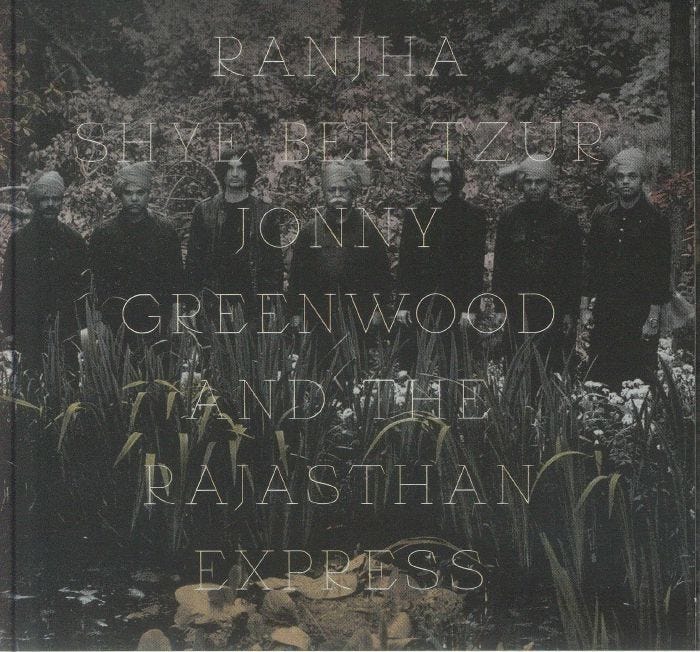
Recording for Ranjha shifted from the grandeur of a historic fort to Greenwood’s studio in Oxfordshire, a deliberate move that produced a tighter, more controlled sound. The album blends Hindi, Urdu, and Hebrew lyrics with brass, harmonium, dholaks, nagara drums, and Greenwood’s keyboards and bass.
Pitchfork describes Ranjha as “subtle, trance like,” highlighting how Ben Tzur’s grounding in Sufi practice and dhrupad tradition shapes its meditative character. Rolling Stone India emphasises the album’s cultural lineage, quoting Ben Tzur’s belief that Ranjha “came from India” despite being recorded in the UK. Greenwood notes that the team intentionally avoided recreating Junun’s atmosphere, instead placing the Rajasthani musicians “out of their comfort zone” to spark new creative dynamics.
Critics have responded warmly. The Financial Times awarded four stars, praising the album’s “bustling and cosmopolitan” feel and its freer, less contemplative tone compared with Junun. Pitchfork rated it 7.0, commending its spiritual cohesion and textural clarity.
Sources: https://en.wikipedia.org/wiki/Ranjha_(album) - https://pitchfork.com/reviews/albums/shye-ben-tzur-jonny-greenwood-the-rajasthan-express-ranjha/ - https://rollingstoneindia.com/shye-ben-tzur-jonny-greenwood-rajasthan-express-ranjha-interview/ - www.uncut.co.uk - townsendmusic.store - www.nonesuch.com.
Where and when to hear Around the World
Friday:
Akaroa World Radio New Zealand - 2:00 pm local time
NAR-GROUP Germany – 2:00 pm local time
Mosel Radio Germany – 2:00 pm local time
NAR-Alf Germany – 2:00 pm local time
Waterwaves Radio England - 9:00 pm local time
Essential Radio Scotland - 10:00 - midnight
Saturday:
Best City Radio Belfast, Northern Ireland - 6:00 am local time
Power 101FM Malawi - 11:00 local time
Flirt FM (Galway’s Community of Interest & Student Station) 101.3 - 10:45 am local time Ireland
Stirling Community Radio - 2:00 pm local time Scotland
RCFM (Radio City FM) Duisburg, Germany - 3:00 local time
World FM New Zealand - 10:00 pm local New Zealand Time
Sunday:
Power 101FM Malawi - 12:00 local time
NFRS Osaka Japan - 12:00 noon local time
973FM in Singapore - 11:00 pm local time
Circl8 Chester England - 12:00 noon local time
DCRFM (Dover Community Radio England - 7:00pm local time
Prodigal Sun Radio - 8:00 pm local time
Slice Audio Northern Ireland - 10:00 pm local time
Holywood Radio - Northern Ireland - Various times
Monday:
Armagh City Radio - 12:00 midnight local time (01:00 pm CET)
SparkFlame Radio - 00:00 am GMT (01:00 CET)
Circl8 Chester England - 12:00 noon local time
Stirling Community Radio Scotland - 10:00 pm local time
Waterwaves Radio England - 9:00 pm local time
BR2 Pure Gold Radio – Costa Blanca, Spain - 10:00 pm local time
World FM New Zealand - 10:00 am local time
Akaroa World Radio New Zealand - 10:00 pm local time
Tuesday:
Waterwaves Radio England - 9:00 pm local time
Wednesday:
World FM New Zealand - 4:00 am local time
Slice Audio Northern Ireland - 4:00 am local time
Pender Radio Pender Island BC, Canada - 3:00 Pacific Time
Best City Radio Northern Ireland - 10:00 pm local time
Radio Skye Scotland - 10:00 pm local time
Thursday:
Waterwaves Radio England - 9:00 pm local time
Music and musicians this week
Orchestra Baobab — “Togne Bakhoul” (Single)
Orchestra Baobab formed in Dakar in 1970, blending Wolof, Mandinka, and Creole influences with Cuban son — a hybrid sound shaped by Senegal’s club culture of the era.
“Togne Bakhoul” continues the band’s trademark mix of Afro‑Cuban guitar lines and Senegalese vocal phrasing, showing how their classic 1970s aesthetic still anchors their modern releases.
Orquesta Akokán — “Mami Qué Qué” (feat. Kiko Ruiz), from América!
Orquesta Akokán is a Havana‑based big band led by singer José “Pepito” Gómez, known for reviving the golden‑age mambo sound with all‑analogue recording techniques and vintage arrangements.
“Mami Qué Qué” features flamenco guitarist Kiko Ruiz, adding Iberian colour to Akokán’s horn‑driven mambo style — a cross‑Atlantic blend that defines the broader palette of América!
MESTIZA — “Báilame”, from Spanish Chica
MESTIZA is a Spanish DJ‑producer duo who fuse flamenco, club rhythms, and pan‑Mediterranean percussion, often sampling traditional palmas and cajón patterns into electronic frameworks.
“Báilame” is one of the standout tracks from Spanish Chica, built around a looped flamenco vocal hook and a driving electronic beat that pushes their folk‑club hybrid into pop territory.
Nana Osei Twum Barima — “Owea”, from Journey to the Unknown
Ghanaian multi‑instrumentalist Nana Osei Twum Barima draws on highlife, palm‑wine guitar, and Akan storytelling traditions, often using call‑and‑response structures rooted in community performance.
“Owea” sits at the reflective end of Journey to the Unknown, weaving acoustic guitar and soft percussion into a narrative about perseverance — a thematic thread running through the album.
Jordan Rakei & Femi Koleoso — It Never Ends (Single)
Jordan Rakei and drummer Femi Koleoso (Ezra Collective) share deep roots in London’s jazz‑soul scene; Koleoso’s rhythmic language is shaped by Afrobeat and UK jazz, giving their collaborations a distinctive percussive lift.
“It Never Ends” pairs Rakei’s introspective vocal style with Koleoso’s live‑drum propulsion, creating a groove‑driven track that bridges neo‑soul warmth with contemporary jazz energy.
Willos’ & Massimo Giuntini — “Best of Luck”, from One for the Road
Willos’ are an Italian‑Irish folk group known for blending Tuscan acoustic traditions with Celtic fiddle repertoire, while Massimo Giuntini is one of Italy’s best‑known uilleann pipers, formerly of Whisky Trail.
“Best of Luck” showcases the album’s cross‑regional folk identity, weaving pipes, fiddle, and guitar into a bright, session‑style tune that reflects the band’s live‑performance roots.
Slavyk — “Biją się powstańcy”, from 11 Songs of Love & Suffering
Slavyk is a Polish/Serbian folk ensemble focused on reviving regional songs from Mazovia and Podlasie, often drawing on archival material and wartime laments.
“Biją się powstańcy” (“The Insurgents Are Fighting”) is one of the album’s historical pieces, built around traditional vocal phrasing and frame‑drum rhythms, reflecting the record’s theme of love, loss, and endurance.
Ichiko Aoba — Sayonara Penguin (Single)
Ichiko Aoba is celebrated for her minimalist, dream‑folk guitar style, often recorded with close‑mic intimacy that makes her work feel almost whispered into the listener’s ear.
Single fact: “Sayonara Penguin” continues her surreal, narrative‑driven songwriting, using soft acoustic textures and impressionistic lyrics to create a gentle, floating miniature typical of her single releases.
Le Diable à Cinq — “On t’attend à cabane”, from Indomptable
Le Diable à Cinq are a Québécois trad‑folk group from Saint‑Élie‑de‑Caxton, known for revitalising regional dance tunes with tight vocal harmonies and fiddle‑driven arrangements.
“On t’attend à cabane” captures the band’s Québécois tradition, blending call‑and‑response vocals with foot‑stomping rhythms that define Indomptable’s lively, communal sound.
Torridon — “Silver Spear”, from Polaroid
Torridon are a Highland folk‑rock band from Inverness, drawing on Scottish storytelling traditions and big‑chorus arrangements shaped by their years on the festival circuit.
“Silver Spear” reworks a traditional reel into a modern folk‑rock anthem, pairing fiddle motifs with driving guitars — a hallmark of Polaroid’s contemporary Celtic fusion.
Luana Flores — “Guerreira de Lança (feat. Chocolate Remix)” [Deluxe], from Cria do Sol Quente
Brazilian producer Luana Flores blends maracatu, coco, and Afro‑Nordestino percussion with electronic production, foregrounding women’s voices and regional rhythms from Pernambuco.
The Chocolate Remix version of “Guerreira de Lança” amplifies the track’s baile‑funk energy, adding sharper beats and club‑focused production to Flores’ original Afro‑Brazilian groove.
Loimolan Voima — “Matkalaulu”, from Il’lan pruazniekka
Loimolan Voima are a Karelian folk ensemble dedicated to preserving Livvi‑Karelian language and musical traditions, often using runo‑song structures and village‑style polyphony.
“Matkalaulu” (“Travel Song”) reflects the album’s focus on seasonal journeys and communal rituals, blending accordion, fiddle, and traditional Karelian vocal timbres.
Charles Maimarosia — “Nanaratana Hu’ A Kuramauri”, from Hote’ Hote’
Charles Maimarosia, from the Solomon Islands, is known for his mastery of Are’are panpipe traditions, blending ancestral techniques with contemporary songwriting.
“Nanaratana Hu’ A Kuramauri” showcases the album’s earthy, percussive panpipe textures, celebrating cultural identity and the rhythmic pulse of island life.
Lila Downs — “Tu Falso Amor”, from Cambias Mi Mundo
Mexican‑American singer Lila Downs draws on Mixtec heritage, ranchera, bolero, and protest song, making her one of Latin America’s most distinctive narrative voices.
“Tu Falso Amor” is a classic Downs blend of ranchera drama and contemporary pop clarity, exploring betrayal and emotional resilience within the broader thematic arc of Cambias Mi Mundo.
El Jarocho — “La Bamba”, from The Secret Museum of Mankind, Vol. 4 (1925–48)
El Jarocho was one of the early recorded exponents of son jarocho, the Afro‑Indigenous‑Spanish folk style from Veracruz built around jarana, requinto, and percussive zapateado.
This archival version of “La Bamba” captures the pre‑commercial, rural form of the song — faster, rawer, and more improvisational than later popular adaptations, preserved in the Secret Museum of Mankind series.
Veera Kuisma — “Hökköpolska”, from Rautavuo
Finnish fiddler Veera Kuisma is part of the new wave of Nordic folk revivalists, drawing on pelimanni dance traditions and regional polska rhythms from Ostrobothnia.
“Hökköpolska” is a driving traditional polska re‑imagined for modern ensemble, showcasing Rautavuo’s blend of rustic fiddle energy and contemporary folk arrangement.
Os Pecados Tropicais — “Cachaça” (Single)
Os Pecados Tropicais fuse Brazilian tropicalismo, surf‑rock guitars, and 1960s psychedelic references, creating a retro‑tropical sound rooted in São Paulo’s indie scene.
“Cachaça” is a bright, percussive celebration of boteco culture, mixing samba‑rock rhythms with vintage organ lines to evoke a sun‑soaked, party‑ready atmosphere.
Tamikrest — “Takma”, from Chatma
Tamikrest are a Tuareg desert‑blues band from northern Mali, blending Kel Tamasheq poetry, electric guitars, and Saharan rhythmic cycles, shaped by the political struggles of their region.
“Takma” is one of Chatma’s standout tracks, built around hypnotic guitar lines and rolling desert grooves, reinforcing the album’s dedication to “the women who inspire the band.”
Marcello De Carolis & Hiram Salsano — “Malandrina”, from Hirundini
Italian chitarra battente virtuoso Marcello De Carolis and singer Hiram Salsano specialise in Southern Italian folk traditions, especially Campanian and Calabrian repertoires.
“Malandrina” highlights the duo’s percussive chitarra battente technique and close‑textured vocal delivery, capturing Hirundini’s focus on revitalising rural Mediterranean song forms.
Bojana Nikolić — POVENULA (Single)
Serbian singer Bojana Nikolić is known for her work with Balkan ethno‑choirs and contemporary folk ensembles, specialising in the powerful, open‑throated vocal techniques of southern Serbia.
“POVENULA” showcases her signature layered vocal polyphony, blending traditional melodic contours with modern production to create a bold, ritual‑like sound.
Trèvol — “Pasdoble dels Turistes”, from Folk d’Extraradi
Catalan group Trèvol fuse rural folk traditions with urban Barcelona influences, often reworking dance‑forms like jotes, pasdobles, and corrandes with contemporary instrumentation.
“Pasdoble dels Turistes” is a playful, satirical take on holiday‑season folklore, pairing brass‑driven pasodoble rhythms with the album’s wider theme of suburban cultural identity.
Airto Moreira & Ricardo Bacelar — “Pé no Chão”, from Maracanós
Airto Moreira is one of Brazil’s most influential percussionists, known for his work with Miles Davis, Weather Report, and Return to Forever, while Ricardo Bacelar is a pianist rooted in Northeastern Brazilian rhythms and jazz fusion.
“Pé no Chão” blends Afro‑Brazilian percussion, jazz harmony, and regional melodic phrasing, reflecting Maracanós’s focus on Brazil’s rhythmic diversity.