

Around the World - Show Notes 23 July 2026
Featured Album this week is Spanish Chica by Mestiza
This week on Around the World
You can listen to Around the World on Mixcloud
The first hour —— The second hour

Music this week by: BALU, Bomba Estéreo, C. Tangana with Gipsy Kings, Nicolas Reyes & Tonino Baliardo, Cristiana Verardo, Fatoumata Diawara, GAOUSSOU ‘SOBRA’ KOUYATE, Gaye Su Akyol, Ibibio Sound Machine, Jiggy, Kareyce Fotso, Kitka, Lemoncello, Luedji Luna, Mah Damba, Mexican Institute of Sound & Meridian Brothers, Milo j, Naked & Lakatos Mónika FolkTrió, NEW ERA QUARTET, Officina Zoe, Rézeleje Fanfárosok, Rhiannon Giddens, SAHAD, Sofia Rei, Tondini, Yerai Cortés, and Youssou N’Dour
There’s more information about all of the musicians and the tracks farther down the page.
Featured Album: Spanish Chica by Mestiza
MESTIZA - SPANISH CHICA | The pulse of Flamenco & electronic music (Arabic, Latin, Spanish House)
Spanish Chica, the new album from Madrid duo Mestiza, marks one of this year’s most striking attempts to rethink how traditional music can evolve on a global stage and to new audiences.
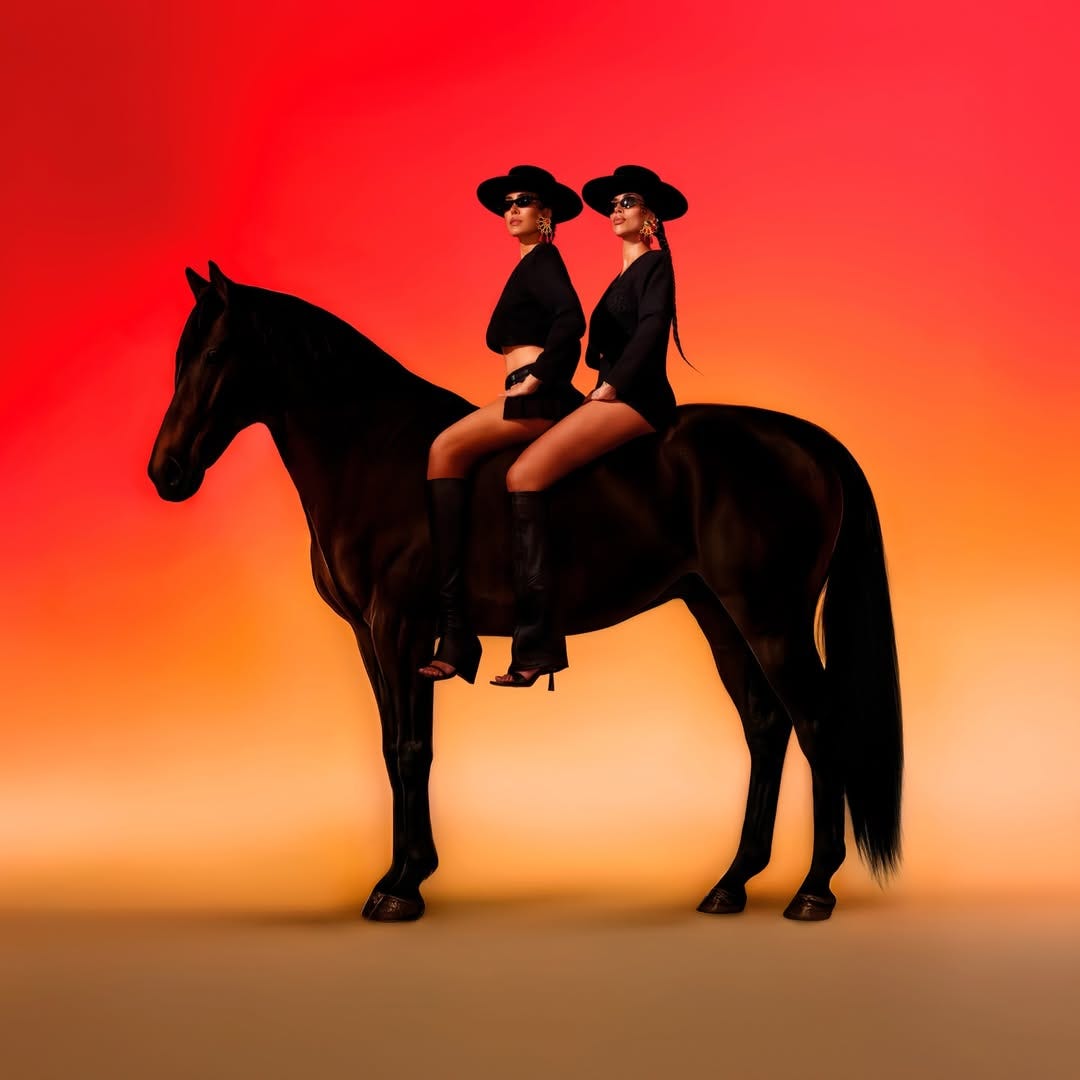
Its significance lies in process as much as sound. Mestiza don’t raid archives or recycle fragments of historic flamenco recordings. Instead, they build their own raw material from scratch. Every palmas pattern, every guitar flourish, every jaleo and vocal ornamentation is performed specifically for the project. These sessions become the album’s foundation, later twisted, looped, stretched and sculpted into club‑ready sounds. The music feels rooted in Iberian tradition yet unmistakably contemporary. And beyond Spain and Flamenco, it touches on Arabic vocals, North African rhythmic accents and a wider Mediterranean palette.
You hear flashes of Andalusian folk beyond flamenco: the lilting phrasing associated with copla, and Spanish folk than to pure flamenco tradition. There are also Latin influences, subtle but present.
For anyone working in world, folk or traditional music, this approach matters. Mestiza aren’t borrowing culture; they’re extending it. Their command of flamenco and Mediterranean folk idioms is deep, but they refuse to treat heritage as something fragile or fixed. Instead, they push it into new territory, showing how traditional forms can thrive inside modern electronic frameworks without losing their soul.
Pitty Bernad and Belah began as DJs crossing paths on Madrid’s club circuit, later realising — on a trip to Mexico — that Spanish folklore belonged on the dancefloor. That spark became their signature fusion, and their rise from underground parties to Ibiza’s main stages has been powered by a distinctly Iberian, distinctly female artistic identity.
Collaboration strengthens that message. Tracks such as Campanera feature established voices like Diana Navarro alongside French electronic duo Faul & Wad.
Spanish Chica earns its spotlight because it captures a wider shift: world music finding fresh life under strobe lights. It’s a reminder that the past doesn’t need preserving in amber — it can dance.
Sources: Mestiza official website - Mestiza Instagram - DJ Mag Spain - Mixmag ES - Beatport News

Where and when to hear Around the World
Friday:
Akaroa World Radio New Zealand - 2:00 pm local time
NAR-GROUP Germany – 2:00 pm local time
Mosel Radio Germany – 2:00 pm local time
NAR-Alf Germany – 2:00 pm local time
Waterwaves Radio England - 9:00 pm local time
Essential Radio Scotland - 10:00 - midnight
Saturday:
Best City Radio Belfast, Northern Ireland - 6:00 am local time
Power 101FM Malawi - 11:00 local time
Flirt FM (Galway’s Community of Interest & Student Station) 101.3 - 10:45 am local time Ireland
Stirling Community Radio - 2:00 pm local time Scotland
RCFM (Radio City FM) Duisburg, Germany - 3:00 local time
World FM New Zealand - 10:00 pm local New Zealand Time
Sunday:
Power 101FM Malawi - 12:00 local time
NFRS Osaka Japan - 12:00 noon local time
973FM in Singapore - 11:00 pm local time
Circl8 Chester England - 12:00 noon local time
DCRFM (Dover Community Radio England - 7:00pm local time
Prodigal Sun Radio - 8:00 pm local time
Slice Audio Northern Ireland - 10:00 pm local time
Holywood Radio - Northern Ireland - Various times
Monday:
Armagh City Radio - 12:00 midnight local time (01:00 pm CET)
SparkFlame Radio - 00:00 am GMT (01:00 CET)
Circl8 Chester England - 12:00 noon local time
Stirling Community Radio Scotland - 10:00 pm local time
Waterwaves Radio England - 9:00 pm local time
BR2 Pure Gold Radio – Costa Blanca, Spain - 10:00 pm local time
World FM New Zealand - 10:00 am local time
Akaroa World Radio New Zealand - 10:00 pm local time
Tuesday:
Waterwaves Radio England - 9:00 pm local time
Wednesday:
World FM New Zealand - 4:00 am local time
Slice Audio Northern Ireland - 4:00 am local time
Pender Radio Pender Island BC, Canada - 3:00 Pacific Time
Best City Radio Northern Ireland - 10:00 pm local time
Radio Skye Scotland - 10:00 pm local time
Thursday:
Waterwaves Radio England - 9:00 pm local time
Music and musicians this week
Bomba Estéreo — Soy Yo (from Amanecer)
Bomba Estéreo is a Bogotá electro‑tropical duo blending champeta, cumbia and electronic pop, active since 2005.
Soy Yo became a global empowerment anthem after its 2015 video went viral for its unapologetic, self‑confident protagonist.
Ibibio Sound Machine — Let’s Dance (Yak Inek Unek) (Single)
Ibibio Sound Machine is a London‑based collective led by Eno Williams, fusing West African highlife with synth‑driven electro‑funk.
The single draws on Ibibio language call‑and‑response traditions, reimagined with punchy, dance‑floor‑ready production.
Tondini — Da Trieste fino a Zara (feat. Divojke) (from Diskolo)
Jelena Tondini is Croatian. Based in the coastal city of Rijeka, she is highly regarded for her unique ethno-disco sound, which frequently rearranges traditional Croatian and Balkan regional heritage melodies into contemporary electronic dance tracks.
The song Da Trieste fino a Zara … From Trieste to Zadar was originally recorded around 1968/1970 by Lidija Pertsan an Istrian Croatian singer who became famous across Yugoslavia for performing songs in Italian and Venetian dialects.
Rhiannon Giddens — Carolina Rain (from Hope Is the Thing with Feathers)
Rhiannon Giddens is a Pulitzer‑winning American roots musician celebrated for reviving African‑American string‑band traditions.
Carolina Rain reflects her North Carolina heritage, weaving folk storytelling with chamber‑folk instrumentation.
SAHAD — We Can Do (from African West Station)
Senegalese artist Sahad blends mbalax, Afro‑folk and jazz, often spotlighting pan‑African musical dialogue.
We Can Do is built around rhythmic guitar patterns and communal vocal lines.
Sofia Rei — Marciana (from Antónima)
Argentine vocalist Sofia Rei is known for avant‑folk explorations that merge Andean traditions with experimental vocal work.
Marciana uses layered vocal loops and percussion to reinterpret South American folk motifs through a modern, art‑pop lens.
Gaoussou “Sobra” Kouyaté — Fadialah (from Sobra Dance)
Gaoussou “Sobra” Kouyaté is a Malian griot guitarist known for blending Mandé tradition with high‑energy, contemporary dance‑band arrangements.
Fadialah appears on Sobra Dance, an album rooted in Mandinka celebratory styles, driven by rapid guitar lines and call‑and‑response vocals.
Lemoncello — Tomorrow Nostalgia (from Perfect Place)
Lemoncello is an Irish duo — Laura Quirke and Claire Kinsella — noted for chamber‑folk song writing.
Tomorrow Nostalgia from Perfect Place pairs their trademark vocal blend with intimate, slow‑burn folk production exploring memory and longing.
Milo j — Ama De Mi Sol (from La Vida Era Más Corta)
Milo j is an Argentine singer‑rapper whose understated, melodic trap‑pop style has made him one of the country’s fastest‑rising young artists.
Ama De Mi Sol sits within La Vida Era Más Corta, a reflective project mixing R&B, neo‑soul and Latin trap with diaristic, coming‑of‑age themes.
BALU — Ya Nzambe (from Borumba, feat. Jupiter Bokondji & Chorale Afrocoeur)
BALU is a Congolese artist working at the intersection of Afro‑fusion and Congolese folk‑pop, often collaborating with Kinshasa’s experimental music community.
Ya Nzambe brings together BALU, Jupiter Bokondji of Okwess, and Chorale Afrocoeur, blending spiritual choral textures with Congolese guitar‑driven groove.
Naked & Lakatos Mónika FolkTrió — Csábitós (from NEKED)
Naked is a Serbian experimental folk‑fusion band, and Lakatos Mónika is a celebrated Hungarian Roma vocalist known for her powerful, ornamented singing style.
Csábitós from NEKED fuses Roma vocal tradition with bold, rhythm‑forward Balkan jazz‑folk instrumentation.
Luedji Luna — Banho de Folhas (from Um Corpo no Mundo)
Luedji Luna is a Brazilian singer whose work blends Afro‑Brazilian rhythms, MPB and neo‑soul, often foregrounding themes of identity and diaspora.
Banho de Folhas became one of her signature songs, built around candomblé‑inspired percussion and a hypnotic, looping vocal refrain.
C. Tangana, Gipsy Kings, Nicolas Reyes & Tonino Baliardo — Ingobernable (from El Madrileño)
El Madrileño marked C. Tangana’s pivot toward pan‑Iberian and Latin folk collaborations, bringing in icons like Nicolas Reyes and Tonino Baliardo of Gipsy Kings.
Ingobernable blends rumba flamenca guitar with modern pop production, becoming one of the album’s standout cross‑generational fusion tracks.
Officina Zoè — Balla balla (from Mari e marenne)
Officina Zoè is a long‑running ensemble from Salento dedicated to reviving pizzica and other trance‑dance traditions of southern Puglia.
Balla balla from Mari e marenne channels the group’s signature tamburello‑driven energy, rooted in the healing and communal aspects of pizzica.
Rézeleje Fanfárosok — Marasztaló csocsek (feat. Balogh Melinda & Békési László) (from Fúgamadár)
Rézeleje Fanfárosok is a Hungarian brass‑folk ensemble known for reinterpreting regional dance tunes with bold, contemporary horn arrangements.
Marasztaló csocsek pairs traditional csocsek dance motifs with featured vocals and clarinet, giving a modern lift to a village‑dance form.
New Era Quartet — Sto Te Nema (from Bridge to Sevdah)
New Era Quartet is an ensemble based in Trieste, Italy exploring sevdah through chambre orchestra styles highlighting the genre’s emotional depth and modal richness.
Their version of Sto Te Nema places a classic sevdah lament into a chamber setting, emphasising voice, bowed strings and restrained improvisation.
Kitka — Došč, Došč (from Kolo)
Kitka is an Oakland‑based women’s vocal ensemble specialising in Eastern European folk and sacred polyphony, noted for precision and unaccompanied harmonies.
Došč, Došč on Kolo showcases Ukrainian folk repertoire, using tight, dissonant harmonies characteristic of Alpine village singing traditions.
Kareyce Fotso — Pedjui (feat. Blick Bassy & Romain Jovion) (from Gwà)
Cameroonian singer Kareyce Fotso blends bikutsi, Afro‑folk and acoustic storytelling, often foregrounding themes of community and resilience.
Pedjui brings together Fotso’s earthy vocal style with Blick Bassy’s delicate falsetto and Romain Jovion’s production, creating a textured, pan‑Cameroonian soundscape.
Cristiana Verardo — Una notte senza dire niente (feat. Rita Marcotulli) (from L’avversaria)
Cristiana Verardo is a singer‑songwriter from Salento whose work blends Italian cantautorato with Mediterranean folk colours.
On Una notte senza dire niente, Verardo’s intimate vocal style meets Rita Marcotulli’s lyrical piano phrasing, adding a refined jazz texture to L’avversaria.
Yerai Cortés — REBELÁ (from POPULAR)
Yerai Cortés is a Madrid‑based guitarist and singer known for modern flamenco that merges traditional toque with urban and R&B influences.
REBELÁ from POPULAR showcases his rhythmic, percussive guitar style and contemporary flamenco phrasing rooted in street‑level storytelling.
Mexican Institute of Sound & Meridian Brothers — Danzón 8bits (from Ruido Tovar)
Mexican Institute of Sound and Colombia’s Meridian Brothers are both known for playful, experimental reinterpretations of Latin genres.
Danzón 8bits reimagines classic danzón through retro‑video‑game sonics and psychedelic tropical instrumentation, fitting the album’s tribute to Rodolfo Tovar’s legacy.
Jiggy — Lasair (Single)
Jiggy is an Irish collective that normally plays straight forward high energy tradtional Irish music.
For the single Lasair (“flame”) is built around bodhrán‑driven rhythm electronic dance music beats.
Mah Damba — Anga Bara (from Taabolo Koura)
Mah Damba is a renowned Malian griotte celebrated for her powerful voice and mastery of Bambara praise‑song traditions.
Anga Bara on Taabolo Koura features her signature vocal intensity supported by ngoni and percussion, rooted in Mandé ceremonial repertoire.
Fatoumata Diawara — Mogo (from Massa)
Fatoumata Diawara is a leading Malian singer‑songwriter whose work blends Wassoulou roots with global pop, jazz and Afrofuturist influences.
Mogo from Massa centres on her distinctive, soaring vocal lines over a modern Afro‑pop arrangement that reflects her pan‑African artistic outlook.
Youssou N’Dour — Tout pour briller (from Éclairer le monde / Light the World)
Youssou N’Dour is Senegal’s most internationally influential mbalax artist, known for blending Wolof percussion traditions with global pop and jazz elements.
Tout pour briller appears on Éclairer le monde, a project centred on uplift and social reflection, pairing N’Dour’s signature vocal clarity with polished, modern mbalax production.
Gaye Su Akyol — İstikrarlı Hayal Hakikattir (from İstikrarlı Hayal Hakikattir)
Gaye Su Akyol is an Istanbul‑based singer whose work fuses Anatolian psychedelia, surf rock and art‑pop, often exploring themes of identity and imagination.
The title track İstikrarlı Hayal Hakikattir (“Persistent Fantasy is Reality”) anchors the album’s surrealist aesthetic, mixing saz‑driven psych‑rock with bold, cinematic arrangements.